

What’s it like to be on the receiving end of you?
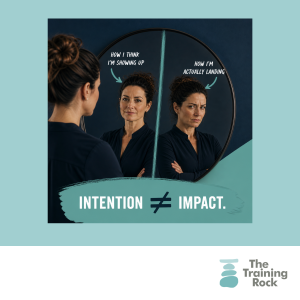
Do you know what the most valuable leadership tool is?
Nope, not the sh*t sandwich.
Not Maslow’s hierarchy of needs, nor whatever shiny new framework is doing the rounds this month.
It’s the humble mirror.
Yep. The mirror.
Not to check your lippy or make sure this morning’s latte isn’t still round your chops, but to check what it’s actually like to be on the receiving end of you.
Not how you think you’re coming across.
Not what you intended.
But how you’re actually landing.
And not just when you’ve had 8 hours sleep and everyone’s behaving themselves either.
I mean the real days.
When you’re tired, frustrated and frankly not in the mood for leadership.
Because that’s when it matters most.
Because here’s the bit most leaders try to skip, instead wanting to go straight to focussing on everyone else’s behaviour:
Owning your impact, especially when things are hard, messy or unfair.
And yes, I bang on about this all the time… because it matters:
If you can’t lead yourself, you’ve got very little chance of leading anyone else.
Self-leadership isn’t about being perfect.
It’s about being honest enough to look in the mirror and say:
👉 “Ah. That didn’t land how I thought it did.”
👉 “I was aiming for assertive… and came across as arsey.”
👉 “I thought I was being clear… but actually I was just being blunt.”
Once you get used to owning your impact, particularly on the hard days, that’s when leadership gets interesting.
Because then (and only then) you can start holding up the mirror for others.
And if your immediate reaction is, “Yes, but I’m not the problem. They need to stop being so difficult…” can I gently point you back to our mantra:
Claim, don’t blame.
Because, frustratingly, the only behaviour you get to control is your own, regardless of how much you’d like to rewrite somebody else’s.
So start with a look in the mirror.
Then, when it’s time to help somebody else reflect on their impact, you can do it without sugarcoating the feedback or wrapping it in two bits of fluffy praise and hoping they’ll spot the point.
Instead, you help them see:
“This is what you did.
This is how it landed.
This is the impact it had.”
Not by telling them they were rubbish, but by asking the kind of questions that hold up a mirror they can’t ignore.
Because great leaders don’t force insight, they create it. They help people reflect on reality, not their imagination, their assumptions or their carefully crafted excuses.
Is looking in the mirror easy?
Nope.
Is holding it up for others easy?
Also nope.
Is it a learnable skill?
Absobloominglutely.
And is it worth it?
Total game changer.
As someone said to me recently after finishing our Leadership Conversations programme:
“The mirror technique really, really, really does work in those ‘yikes’ moments, doesn’t it?”
Yes.
Yes, it really, really, really does.
And if you’re still blaming someone else for everything that’s not going well… chances are you haven’t looked in the leadership mirror properly yet.
So… one final question:
When was the last time you looked in the leadership mirror… and didn’t just see what you wanted to see? 👀
Rock on,
Jo
P.S. If you’ve got a conversation you’re avoiding right now… there’s a good chance the mirror is the place to start.